
Video to Video AI Free: Every Free Page Promises the Motion Survives, and None Lets You Check
A 4-second clip with a fast whip pan was handed to the four pages that accept a clip among the ten Google returns for this phrase on 21 October 2026. All four took the file. None produced a restyled frame — each stopped at an account gate, and the clip never left the machine, with the largest upload to any tool host at 35,817 bytes against a 679,144-byte clip.
- Model
- Video-to-video restyling, free tiers
- Observed
Four of the ten pages Google returns for this phrase accept a video without an account. All four were handed the same 4-second clip — a 1,056 pixel-per-second pan followed by a rotation at 6 radians per second, 679,144 bytes — on 21 October 2026. All four took the file. Not one produced a restyled frame, and the clip never left this machine: the largest upload to any of those tool hosts was 35,817 bytes. So the question this page exists to answer — whether a fast-motion shot comes back smeared or flickering after style transfer — has no answer from the free tier. What can be reported is where each page stops, and what each one claims while stopping there.
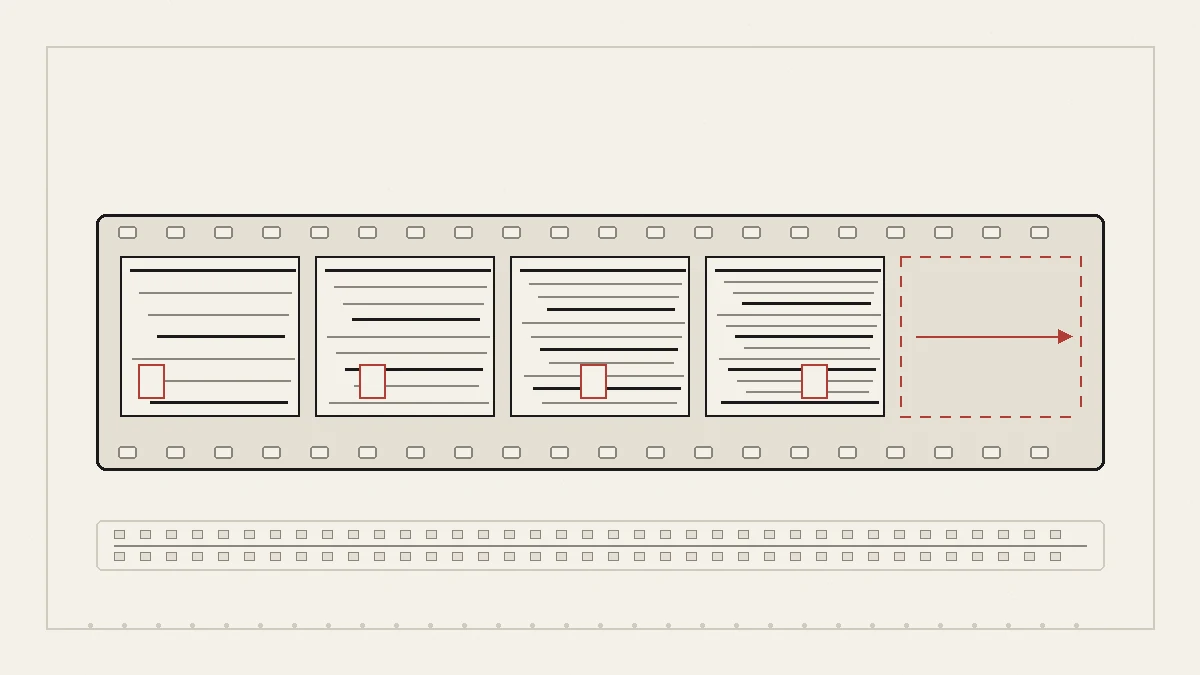
This is one run on one Windows machine, on the pages that the US results returned for this phrase, with no account signed in anywhere. It is a record of what the pages did, not a record of what they say they do. The wording in the table below is quoted from the live pages on the same day, because the claim being tested is theirs.
The clip, and the two numbers that would have answered the question
The layer is narrow on purpose. Style transfer has one characteristic failure on fast footage: the model cannot keep up with the motion, so edges smear across frames, or the style flickers frame to frame while the underlying picture is still. Both are measurable, and neither needs an opinion.
The clip was built to expose exactly those two failures. Its first two seconds are a fast lateral pan across a detailed test pattern, at 1,056 pixels per second — about two and a half frame widths every second. Its second two seconds are a rotation at roughly one revolution per second, which is the hardest case for a model that processes frames independently. Along the right edge, 160 pixels wide and a quarter of all pixels, sits a completely static detailed strip. That strip does not move in the source at all, which makes it a clean place to look for flicker: if it moves in the output, the tool moved it.
Two numbers come out of that. Sharpness is the variance of the Laplacian over each frame, with both input and output scaled to 640×360 first so a resolution change is not scored as blur. Flicker is the frame-to-frame change in brightness averaged over the pixels that never move in the source.
Both were checked against known-bad samples before any page was touched. The same clip compared with itself scores 1.000 on sharpness and 0.002 on still-area flicker, so the instruments do not invent either fault. A copy blurred with a Gaussian of σ=3 scores 0.019 — the drop is unmistakable. A copy with a brightness jitter of ten per cent per frame scores 15.803 on still-area flicker, against 0.002 for the untouched clip.
That is the whole apparatus: two numbers, calibrated on synthetic faults, ready to read a restyled clip. No restyled clip arrived.
The four pages that took the clip, and where each stopped
| Page | Google rank | Its own sentence about motion | What happened with the clip |
|---|---|---|---|
| easemate.ai | 1 | "the generated video will keep the original motions intact" and "No more blurry transitions or artificial effects" | Clip accepted, played back in the page at 0:04, free quality locked to 480p. Generate button stayed disabled; pressing it raised a signup panel. 17,209 bytes upstream |
| heyvid.ai | 2 | "Each transformation maintains smooth motion and temporal consistency" | Clip accepted, prompt typed. Page states "Required credits: 90". Generate opened a login box. 9,007 bytes upstream |
| domoai.app | 3 | "Keep your original motion perfectly intact" | Clip accepted, prompt typed. Page states "Sign up to generate for FREE"; the generate button is disabled with no account. 16,930 bytes upstream |
| magichour.ai | 4 | "changes art styles while keeping motion intact" | Clip accepted and given its own 4-second player. "Generate Preview" raised "Get Full Access … Start with 400 free credits" twice. 24,408 and 35,817 bytes upstream on two runs |
The middle column matters more than it usually would. Four pages, four separate sentences, and the two properties being promised are the two properties this test was built to measure: motion that stays smooth, and frames that stay consistent with each other. None of the four lets a visitor check either sentence without an account.
EaseMate: the file is in, and the button is not
EaseMate is the top result and the most complete free surface of the four. The clip attached, the page rendered it back at 0:00 / 0:04 with the correct first frame, and the tool exposed a quality selector whose only free option reads 480p. The generation prompt box accepted text.
Then the button. It renders in a washed-out state that the page never lifts for a visitor without an account, and pressing it does not start a job — it raises a promotion for a newer model whose fine print reads "By signing up, you agree to our Terms of Service and Privacy Policy". The same thing happened twice, the second time after the overlay was closed and the button pressed again.
The byte ledger is what makes this a finding rather than an impression. EaseMate's own host received 17,209 bytes upstream across the whole session, and 10,045 in the second attempt. The clip is 679,144 bytes. A tool that had started a job would have had to send the file; nothing was sent.
HeyVid: ninety credits, and a login box
HeyVid is the most explicit of the four about the price. Before the clip is even chosen, the panel reads "Required credits: 90" next to the generate button, and the page's own navigation offers a Sign In. The clip attached cleanly — the file input kept it, unlike two of the others — and the prompt box counted 35 of its 10,000 characters.
Pressing Generate produced a login dialog with Google sign-in, email and password, and a Sign Up link. No job, no queue, no output. Upstream traffic to heyvid.ai over the session was 9,007 bytes.
DomoAI: the generate button is disabled
DomoAI's page is the one that says it plainest — "Sign up to generate for FREE" — and its behaviour matches the sentence exactly. The clip attached, the prompt box took text, and the generate button, which carries its own cost in its label, never became clickable. The automation could not press it because there was nothing to press: the element is disabled in the document, not merely covered.
Upstream to the tool's own host was 16,930 bytes. As with the other three, the file stayed local.
Magic Hour: the free preview never rendered
Magic Hour is the only one of the four that advertises a way to see something before signing up. Its own instructions say: "Preview the first frame here, then sign up to restyle the full video." That is a real offer — a single restyled still, no account needed, which would have answered the sharpness half of this page's question even without the flicker half.
It did not happen. Pressing "Generate Preview" twice, once with no style selected and once with the Anime style selected, produced the same panel both times: "Get Full Access — Sign up to gain full access to the tool and other benefits. Start with 400 free credits." No preview image appeared in the page.
What did move was the counter. It read "3 images left today" on arrival and "1 image left today" after the two presses, so the page counted both attempts as consumed even though neither returned an image. That is worth stating precisely because it is the kind of detail a summary would round away: two attempts, two units deducted, zero frames produced.
The pages that never offered a clip
Six of the ten never reached the question. Four of them — invideo, Runway, Kling and VEED — serve landing pages with no file input at all, because the tool they rank with is a text-to-video or an editor product rather than a restyler. OpenArt's input accepts images only. Pollo, which stands in for a Reddit thread that cannot be read from this network, returned a Cloudflare interstitial with the title "Just a moment…", so nothing about it is reported here.
Naming those pages matters for the same reason the stall on a previous page mattered: a page that never opened its tool has not been shown to gate anything. It simply was not the thing being tested.
Why "motion intact" stays untested on the free tier
Put the four pages side by side and a pattern appears that no single page states. Each offers a real upload surface. Each accepts the file. Each then requires an account before a single frame is restyled — and each does it at a different point: one disables the button, one raises a login dialog, one raises a signup pitch, one counts your attempts while refusing to render them.
That arrangement makes the marketing sentence unfalsifiable from the outside. "Keeps motion intact" and "maintains temporal consistency" are claims about a rendered clip. If no clip is rendered until after signup, a visitor cannot test the claim, and a reviewer cannot contradict it. The free tier is not a sample of the product here; it is a preview of the upload widget.
There is a second, smaller cost worth naming. Magic Hour deducted two of its three daily previews without producing either preview. Whatever the allowance is worth, it was spent on nothing observable, which is a fact about this run on this day and not a claim about the product's intent.
What was not measured, and what would change the answer
Nothing on this page says a restyled fast-motion clip is blurry, and nothing says it is clean. Neither was seen. The instruments are calibrated and idle; the missing input is a rendered frame.
Three things would close the gap, and all three need an account: a free-tier render on any of the four, a first-frame preview from Magic Hour's advertised path, or any tool that restyles without asking who you are. If one of those produces a clip, the reading is mechanical — sharpness ratio against the source, and still-area flicker against a strip that never moves. A ratio near 1 with flicker near 0.002 means the motion survived; a sharpness ratio in the hundredths means it did not.
Until then the honest summary is the one in the first paragraph: four pages promised the motion survives, four pages took the file, and none of them showed what came back.
The site's ledger of free-tier observations — each figure with the channel it was seen on, the date it was observed, and whether it came from a vendor statement, a report or a single observation — is published as CSV, JSON and Markdown on the data page.
Where this run is kept
The clip, the calibrated samples, the frame reader, the byte ledger and the screenshots from each page are dated and stored together, so every number above can be traced to the run that produced it. Nothing here is an average, an estimate or a projection; it is one day's reading, and it will be re-run rather than revised if the pages change.