
Free AI Video Generator App: Do the Phone App and the Website Share One Free Allowance?
Ten pages rank for this phrase across the Play Store, the App Store and the open web. Read in full on 20 October 2026, not one of them says whether the free allowance you spend in the phone app is the same allowance you spend in a browser — and one of the ten says its desktop web version has not shipped yet.
- Model
- AI video generator apps, free allowances across app stores and web
- Observed
Ten pages rank for this phrase across the Play Store, the App Store and the open web. Read in full on 20 October 2026, not one of them says whether the free allowance you spend in the phone app is the same allowance you spend in a browser. Runway publishes a number — "The Free plan includes 125 one-time credits" — and puts "Android app" and "iOS app" links in the same navigation bar, and still does not connect the two. Kling lists four download targets in its footer and answers "Is Kling AI a free AI video generator?" with "Yes", while saying the credits "depend on current account and promotional conditions". invideo's web page answers "Do I need to download any software?" by calling itself "a web-based tool". Picsart's only sentence that touches both surfaces is a paid-tier benefit. Meta's Vibes page offers two store links and says its "desktop web experience" is "coming soon". And the app sitting first in the Play results publishes an app description with no mention of free, free credits or a trial anywhere in it.
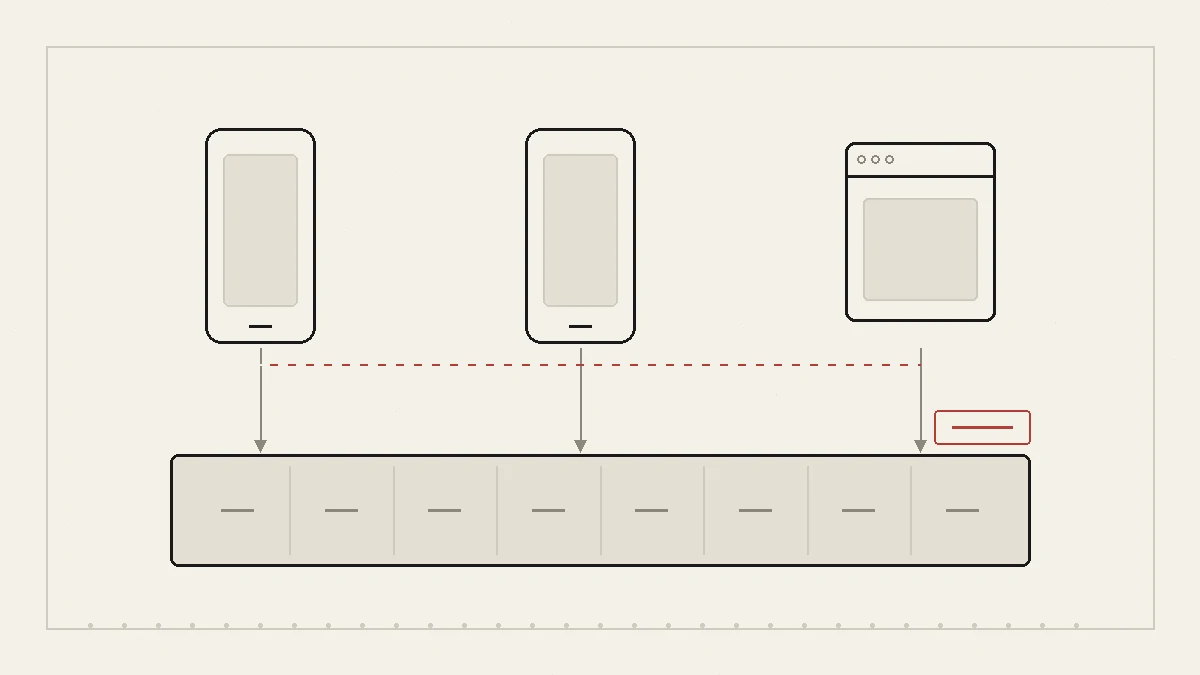
Measured on 20 October 2026 on one Windows machine, in a browser with no account signed in to any of these services, reading the pages Google's US results return for this phrase and the pricing page behind each product. Every quotation below is the page's own sentence, copied without edits. Where a page could not be read, the row says so.
The question this page is about
An app that exists on three surfaces raises one question a free tier has to answer: is there one allowance, or three? If it is one, signing in on a second device buys you nothing you did not already have, and a free allowance is a budget you have to plan across phone, tablet and browser. If it is three, each install is a fresh start, and the number printed on a pricing page describes only the subset of it you happen to be using.
The difference decides how you spend the thing. It also decides whether a listing that says "Free · In-App Purchases" tells you anything about the web version at all — and whether a pricing page that says "125 one-time credits" is describing what you get on the phone.
None of the ten pages states it. That silence is the finding on this page, and the rest of it is the evidence that the silence is uniform rather than a single page's omission.
What each page gives you to go on
Each page was read in full. This table records only what it actually puts in front of a visitor: which surfaces it offers an entrance to, and whether it names an allowance.
| Page | Entrances offered on the page | Allowance stated on the page | Says one pool, or not |
|---|---|---|---|
| Play Store: AI Video (HubX), rank 1 | Play only | None. The app description contains no "Free", "free", "credits" or "trial" | Not stated |
| App Store: invideo, rank 2 | iPhone, iPad, Apple Vision compatibility rows | "Free · In‑App Purchases", plus a list of in-app purchase prices | Not stated |
| invideo.io, rank 3 | None for a phone; calls itself web-based | "Get started, It's free!" | Not stated |
| kling.ai feature page, rank 14 | iOS, Android, macOS, Windows | "Kling AI offers free generation options for eligible users" | Not stated |
| picsart.com, rank 15 | "on the web, in the app, or inside the AI tools you already use" | The free question is answered with subscription credits | Not stated |
| Play Store: PixVerse, rank 6 | Play, plus a link to its official hub and API domains | None in the description | Not stated |
| ai.meta.com Vibes, rank 7 | Play and App Store links; desktop web marked "coming soon" | None | Not stated |
| App Store: VideoGPT, rank 8 | iPhone only | "Free · In‑App Purchases" | Not stated |
| runway.com, rank 9 | "Android app ↗ iOS app ↗" in the navigation | "The Free plan includes 125 one-time credits." | Not stated |
| YouTube, rank 10 | Not a tool | None | Not a tool |
The last column is the same for every row, and that is the point: across ten pages, three of which publish a named credit figure or an explicit free-tier description, the relationship between the phone application and the website is never described.
The pages that come closest
Four pages have both halves of the answer in their own words and still do not join them.
Runway is the most complete case, because it is the only one that publishes a number and a phone entrance side by side. Its FAQ says, of the free plan, "The Free plan includes 125 one-time credits." Its pricing page repeats it: "Free forever. For people looking to explore Runway's AI Tools $0 /month 125 credits", and its credits FAQ adds "the Free plan includes a one-time deposit of 125 credits that doesn't expire." The same navigation that carries that pricing link also carries "Android app ↗" and "iOS app ↗". Nothing on either page says whether the 125 is per plan, per account or per surface — so a reader who wants the phone app cannot tell whether the number they just read is the number they will get.
Kling goes further on the free question and stops at the same place. Its FAQ answers directly: "Yes. Kling AI offers free generation options for eligible users, although available credits and features depend on current account and promotional conditions. You can check your credit balance and the cost of a generation before creating a video." A second answer covers watermarks: "free-tier exports generally include a watermark. Watermark removal is a membership benefit." The page footer lists all four download targets — "iOS", "Android", "macOS Apple Silicon Intel" and "Windows". So the page says there is a credit balance you can check, and offers four places to spend it from, and does not say whether "current account" means one balance or four.
Picsart has the closest sentence in the sample, and it is not about the free tier. Its pitch is "Use Picsart anywhere Create on the web, in the app, or inside the AI tools you already use." Its pricing page then puts the sharing language inside a paid tier: "Access projects on mobile app and on web platform" and "Subscription access on multiple devices", both listed among Pro and Ultra benefits. What crosses devices, on this page's own account, is a subscription — not a free allowance.
invideo resolves the question by removing one of the surfaces. Its generator page answers "Do I need to download any software to use the AI video generator by Invideo AI?" with "No downloads are needed to generate videos using Invideo AI. It is a web-based tool, and it works well on all popular browsers such as Safari, Google Chrome, and others on all devices from mobile to desktops." That is a browser claim, not an app claim. Its App Store listing is a separate product with its own compatibility rows and its own purchase list, and the generator page never mentions it.
The two that say the least
The first result on the Play Store is an app whose description never uses the word free. The text in the description is about what the tool does — "Create scroll-stopping videos from a simple prompt or photo in seconds with AI Video, trusted by 30+ million users worldwide" — and the only commercial signal on the listing is the "In-app purchases" badge next to the developer name. Whatever the free allowance is, this listing does not name it, so there is nothing here to compare across surfaces even if the app shipped on three.
Meta's Vibes answers the three-surface question by not yet having the third surface. The page title reads "Vibes: Generate free AI videos", which is the strongest free claim in the sample, and the page then offers exactly two ways in: a Play Store link and an App Store link. The desktop mention is future tense, and the sentence after it is the answer: "Get even more advanced tools and more space to create with our desktop web experience. Advanced creation tools coming soon. Get notified." A page that says "free" in its title, and whose web version is a sign-up form for a product that has not shipped, has nothing to say about a shared allowance because there is no second surface to share with yet.
What could not be read
Two of the pages that would most likely settle this could not be opened, and the rows above say so rather than being filled in.
PixVerse's own hub, app.pixverse.ai, is the one link its Play listing offers besides the API domain. Opened in a browser on 20 October 2026 it served a Cloudflare human-verification page — the page title was "Just a moment...", the body was 261 bytes of challenge text, and nothing behind it could be read. Kling's /pricing path redirected to the site's marketing front page, which is a brand page and carries no allowance line. Both gaps are recorded here as gaps; neither is described from a neighbouring row or from a third-party summary.
What this does and does not establish
It establishes that, as of one day of reading, the ten pages ranking for this phrase do not state whether a free allowance is shared across the phone app, another store, and the browser — including the three pages that publish a free-tier description in their own words. It establishes that the strongest cross-surface sentence in the sample belongs to a paid tier, and that the page whose title says "free" has no web version to compare against.
It does not establish that these allowances are separate. A company can share one pool without ever writing it down, and several here plausibly do — a sign-in based credit balance is the obvious design. What is missing is not the behaviour but the statement, and a reader planning around a free tier is being asked to run an experiment to find out which it is.
It also does not cover what happens inside either app. Nothing here was signed in, so no in-app balance was checked and no generation was spent on either surface. The scope is the pages: what they publish, and what they leave out.
The site's own ledger of AI video free tiers — each figure carrying the channel it was observed on, the date, and whether it came from a vendor statement, a report or a single observation — is published as CSV, JSON and Markdown on the data page.
Where the record of this run is kept
The raw HTML and text of all ten ranked pages, the five pricing pages opened behind them, the screenshots taken at the point of reading, and the verbatim sentence each quotation was lifted from are dated 2026-10-20 and stored together, so every cell above can be traced back to the page it came from. No cell is filled in from a neighbouring row, and no row says "no" where the page was merely unreadable.