
Kling 4.0 vs Seedance 2.5: What Five Seconds Actually Costs
Kling 4.0 charges 50 credits for five seconds at 720p, read off the logged-in generator on 26 October 2026 — 10 credits a second. At the prices Kling sells credits for that is $0.35 to $0.54, against $0.84 to $1.68 for the same clip on Seedance 2.5.
- Model
- Seedance 2.5
- Observed
A five-second Kling 4.0 clip at 720p costs 50 credits, read off the logged-in generator on 26 October 2026. That works out to 10 credits a second, and the rate holds exactly from 3 seconds to 15. Converted at the prices Kling sells credits for, those 50 credits are $0.35 to $0.54. The same five seconds on Seedance 2.5, priced through the one channel found here that publishes a per-model credit cost, is $0.84 to $1.68. The gap is real. It is also 1.6x to 4.8x, which is not the same thing as the flat "5x" the comparison videos keep putting in their titles.
Both figures are arithmetic on published prices, not bills. Nobody at either company has stated a per-clip dollar cost, because neither company prices in dollars — they price in credits they also sell. The only way to answer "which is cheaper" is to convert both sides into the unit the question is actually asked in. Below is what each side publishes, what the conversion assumes, and where the "5x" claim comes from.
The rate Kling 4.0 actually charges
Kling does not publish this on a page anyone can read. kling.ai/pricing redirects to the marketing homepage whether or not a session is signed in — 36,389 characters of copy with no credit figure in it. The plan table lives at kling.ai/app/membership/membership-plan, and the per-generation cost appears only in the generator, after login.
Driving the generator's parameter panel on 26 October 2026 and reading the cost line under it:
| Kling 4.0 setting | 3 s | 5 s | 10 s | 15 s | Per second |
|---|---|---|---|---|---|
| 720p | 30 | 50 | 100 | 150 | 10 credits |
| 1080p | — | 75 | 150 | — | 15 credits |
The progression is linear, not stepped, and the output count multiplies it linearly too: 10 seconds at 720p with three outputs quotes 300 credits, three times the single-output price. 4K appears in the same panel as Coming Soon and cannot be selected, so there is no 4K rate to report.
One reading trap is worth recording, because it nearly produced a wrong number here. The cost line lags a parameter change by a second or two. A first pass that set 3 seconds with three outputs read 300 credits, which divided by three implies about 100 credits for a three-second clip — a figure that contradicts the 10-credits-a-second slope. Resetting the output count to one and re-reading gave 30 credits for three seconds, which fits. The cost line has to be read after it settles, and it has to agree with a second, independent path — here, the slope across four durations — before it is quoted.
The tier table, and the discount hiding in its arithmetic
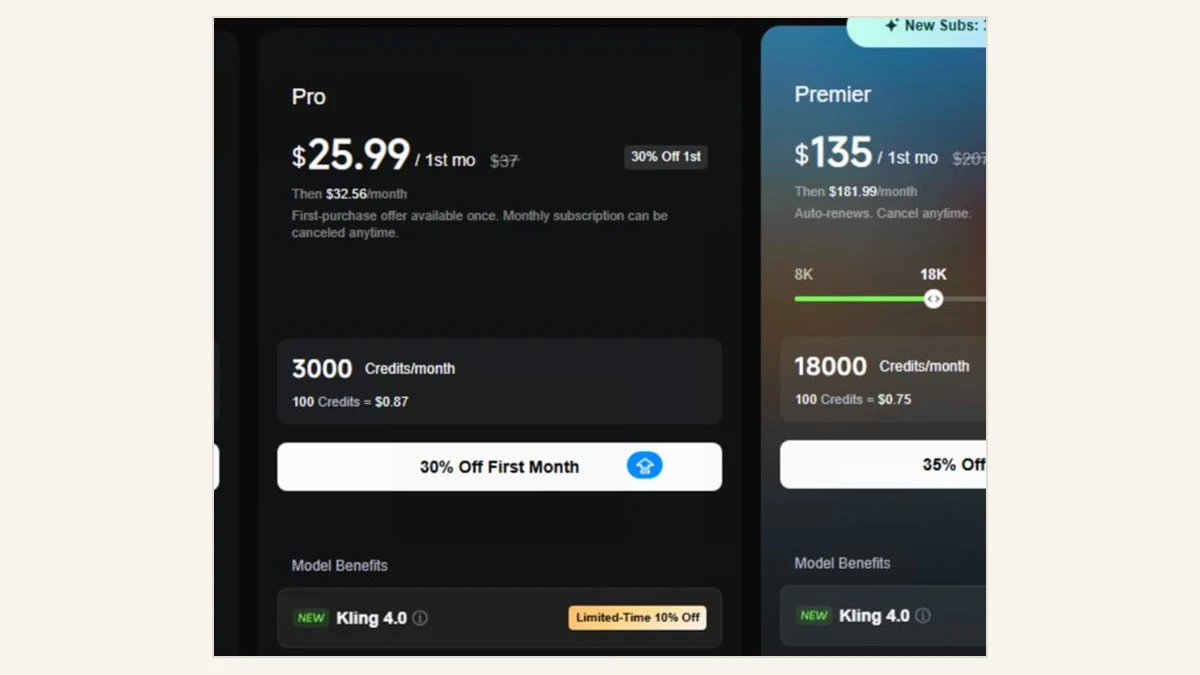
Kling sells credits four ways on monthly billing. The prices and allowances below are the ones the page shows on 26 October 2026:
| Tier | First month | Renewal | Credits a month | Page's own line | Kling 4.0 |
|---|---|---|---|---|---|
| Standard | $6.99 | $8.80 | 660 | 100 credits = $1.06 | not included |
| Pro | $25.99 | $32.56 | 3,000 | 100 credits = $0.87 | included |
| Premier | $135 | $181.99 | 18,000 | 100 credits = $0.75 | included |
| Ultra+ | $402 | $544.99 | 57,000 | 100 credits = $0.71 | included |
That "100 credits = $X" column is the one everyone quotes, and it is computed on the discounted first month, not the renewal price. The four tiers confirm it: 6.99 divided by 660, 25.99 by 3,000, 135 by 18,000 and 402 by 57,000 all reproduce the printed figure to the cent. Run the same division against the renewal column and 100 credits costs $1.33, $1.09, $1.01 and $0.96 — a quarter to two-fifths more, depending on tier. Anyone converting credits to dollars off that column without saying which price it is built on is quoting a promotional rate as if it were the standing one.
The tiers also changed under the page's feet. On 3 October 2026 the same table listed Premier at 8,000 credits for $64.99 and an Ultra tier at 26,000 for $127.99; by 26 October Premier carries 18,000 at $135 and Ultra has become Ultra+ at 57,000 for $402, under a banner reading "New Tiers Launch: Up to 40% Off". Both readings are kept on this site rather than reconciled, because neither is wrong — the product moved.
Kling 4.0 is not on the cheapest tier. The plan table's Model Benefits block lists "Kling 4.0 — Limited-Time 10% Off" on Pro, Premier and Ultra+, and on Standard it lists only "VIDEO 2.6 — Voice Control" and "Element AI Multi-Shot". So the floor for using the model at all is Pro, and the floor for a five-second 720p clip is 50 credits against Pro's 3,000.
Both models in the same unit
Seedance 2.5's side comes from Invideo, the one channel found here that publishes a per-model credit cost beside the price it sells credits at: roughly 56 credits per five seconds at 720p and roughly 96 at 1080p, with credits at $0.015 each on annual billing and $0.03 on monthly. The tilde is Invideo's, and it matters — those are stated approximations, not measured deductions.
| Five seconds | Kling 4.0 | Seedance 2.5 | Gap |
|---|---|---|---|
| 720p | $0.35 – 0.54 | $0.84 – 1.68 | 1.55x – 4.77x |
| 1080p | $0.53 – 0.81 | $1.44 – 2.88 | 1.77x – 5.45x |
The ranges are not noise. On the Kling side the low end is Ultra+ at the discounted first month and the high end is Pro at renewal — the two tiers a real customer is most and least likely to land on. On the Seedance side the low end is annual billing and the high end is monthly. A single number would have to pick one tier from each table and pretend the other six combinations do not exist.
Where "5x" comes from
The "5x" in those video titles is not invented. It is the product of comparing opposite corners: Seedance at monthly billing, $1.68 for five seconds at 720p, against Kling at Ultra+ first-month pricing, $0.352 — 4.77x. Line those two up and the claim nearly holds. Compare like with like, renewal against renewal, and the same pair of clips is 1.5x to 2x apart.
Which is why the honest answer to "is Seedance worth 5x the price" is that the question contains a number the pricing does not support as a constant. The multiple moves by a factor of three depending on which plan each side is bought on, and the two vendors' credits are not comparable units at all — a Kling credit and an Invideo credit are different currencies that happen to share a name. Only the dollars are comparable, and the dollars depend on the plan.
What this does not settle
Three things remain open, and none of them is small enough to round away.
Kling's plan table tags Kling 4.0 with "Limited-Time 10% Off" without saying what the discount applies to. If it applies to generation cost, the 50 credits read here is already a discounted figure and the list price would be about 55.6 — which would move every dollar figure in this page upward. The page does not say, and no other Kling page states a list rate for the model, so the 50 is recorded as observed and nothing is extrapolated from it.
The free trial package on the account used for these readings carried 66 credits expiring 3 November 2026, and the generator separately showed three trials remaining. Whether those trial credits can pay for a Kling 4.0 generation is not stated anywhere and was not tested — spending them to find out would have destroyed the evidence. Until it is tested, no claim is made about trying Kling 4.0 for free.
The 4K tier is listed as coming soon, so the resolution where the gap might be widest has no published price on either side of this comparison.
Kling's own numbers move without announcement — the tier table changed inside four weeks — and Seedance 2.5's only public per-model cost carries the vendor's own approximation marker. Re-read both before quoting either. The dated readings behind this page are in the site's dataset, with the channel and the date each was taken.
Related on this site: Seedance 2.5 credits to dollars — the Invideo conversion in full, including the plan table it divides. Seedance 2.5 unlimited — which models get an unlimited entry, and which queue it runs in. Kling AI free tier — what the 66-credit trial package actually funds.